

Introduction
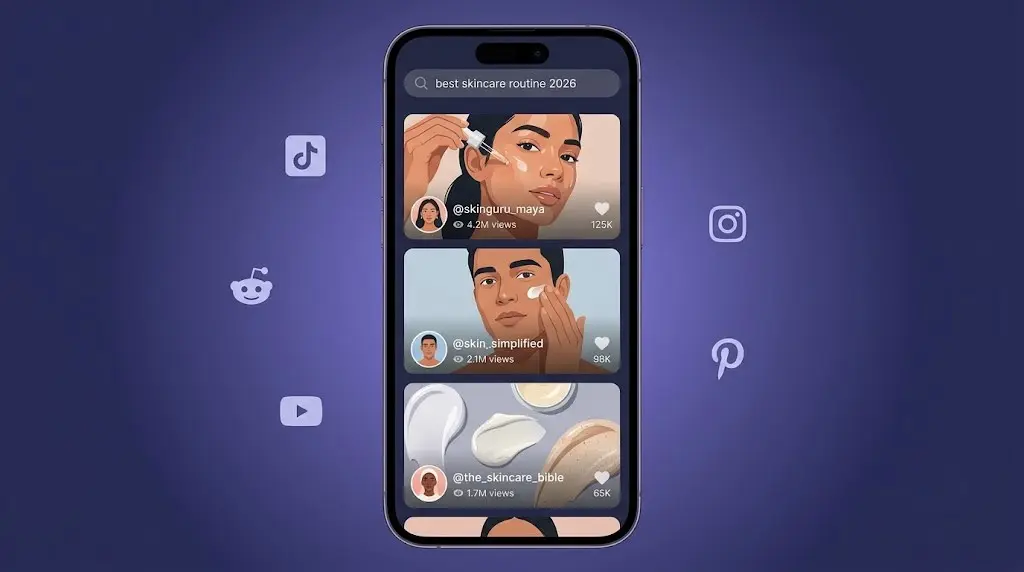
Social search is no longer a secondary behavior happening alongside Google — it has become the primary discovery channel for a growing share of buyers in 2026. People now search on TikTok for product reviews, on YouTube for tutorials, on Instagram for local recommendations, on Reddit for community opinions, and on Pinterest for shopping ideas — often checking comment sections before they ever click out to a website. <cite index=”13-1″>Sprinklr has gone as far as calling social the primary search layer for many buyers, especially younger audiences.</cite>
This is not a generational novelty. It is a structural shift in how buying decisions begin. If your business still writes captions as random brand slogans and ignores searchable phrasing, you are losing discoverability at the exact moment where intent is already high. This guide covers what social search actually means in 2026, which platforms drive it, how to optimize for it, and what the data says about where it is heading.
📋 TL;DR — Social Search in 2026
- Social search is now the primary discovery layer for buyers under 35 — ahead of Google for many journeys
- 74% of shoppers convert from creator-led content (Sprout Social, June 2026)
- Google now indexes public Instagram content and short-form videos in traditional search results
- 52% of social users distrust brands posting AI content without disclosure
- Search-first captions — naming the product, problem, and user type — outperform slogans on every platform
- AI-generated video ads surged +265% on Fiverr in the first half of 2026 — but human editing demand grew alongside it
What Is Social Search — and Why Is It Dominating Discovery in 2026?
Social search is the behavior of using social media platforms as primary search engines — typing queries into TikTok, YouTube, Instagram, Reddit, or Pinterest the way a previous generation typed into Google. In 2026, this behavior has matured from a niche pattern among Gen Z into a mainstream discovery mechanism spanning multiple demographics and purchase categories.
The mechanism driving it is straightforward: social platforms surface results with social proof already attached — views, likes, comments, and creator credibility are all visible before a user clicks anything. Traditional search results surface links; social search surfaces validated experiences. For buyers evaluating a purchase, that difference in trust signal is decisive.
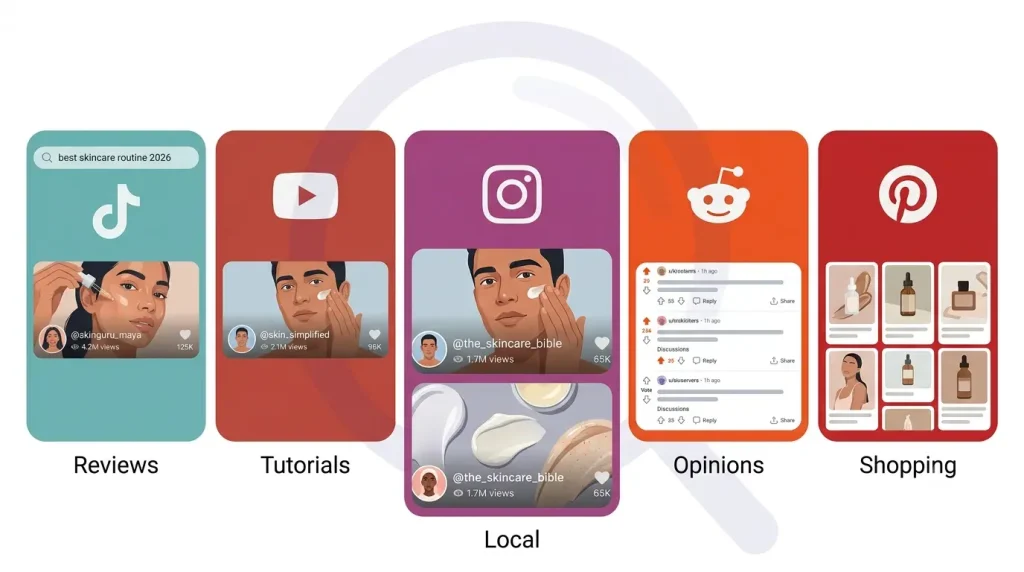
<cite index=”13-1″>People look for product reviews on TikTok, tutorials on YouTube, local recommendations on Instagram, community opinions on Reddit, and shopping ideas on Pinterest — and they check comment sections before they click out.</cite> The comment section has become the 2026 equivalent of reading customer reviews — and for many categories, it carries more weight.
Why this shift is accelerating in mid-2026:
- Google now indexes public Instagram content and short-form videos from social platforms, blurring the line between social search and traditional SEO
- AI-generated content saturation on traditional search has increased the perceived authenticity premium of creator-led social content
- Platform algorithms increasingly reward content with high search-match relevance — not just engagement — incentivizing brands to write searchable captions
Why Is Social Search the Proven Strategy Outperforming Traditional SEO for Younger Buyers?
Social search consistently outperforms traditional SEO for buyers under 35 because it combines search intent with immediate social proof in a single interface. According to Sprout Social’s June 2026 social media trends report, social media search is now outpacing traditional SEO for many buyer journeys, with 74% of shoppers converting from creator-led content — a conversion rate that makes social search one of the highest-ROI discovery channels available.
The authority mechanism behind this is well-documented: social content that generates high virality and engagement satisfies search engines’ E-E-A-T criteria. This means social proof — shares, saves, comments — is not only a platform-level signal but increasingly a Google-level signal too, as Google indexes high-performing social content directly into traditional SERPs.
Why social search converts differently than paid or organic search:
| Channel | Trust Signal | Speed to Trust | Conversion Trigger |
|---|---|---|---|
| Google organic | Domain authority, backlinks | Slow (months to build) | User clicks, reads, decides |
| Google paid | Brand credibility + ad | Immediate but skeptical | CTA-driven, no social proof |
| Social search | Creator credibility + comments | Instant (visible before click) | Social proof + peer validation |
| Social creator content | Personal recommendation | Highest trust level | Perceived authenticity |
Which Platforms Drive Social Search — and How Does Each One Work?
The five platforms driving social search in 2026 are TikTok, YouTube, Instagram, Reddit, and Pinterest — each with a distinct search behavior, content format, and optimization approach. Google Lens, processing over 20 billion searches per month, represents the visual search layer sitting across all of them.
TikTok — Product reviews, tutorials, trending purchases TikTok’s search bar is now used by a significant share of users as a first-stop research tool, particularly for beauty, fashion, food, and tech products. Search-optimized TikTok content names the product, the problem, and the use case explicitly in the first 3 seconds and in on-screen text. The algorithm’s For You Page (FYP) distribution means social search content can compound organically without a large follower base.
YouTube — How-tos, comparisons, long-form discovery YouTube remains the dominant platform for high-intent, research-stage queries. Users searching “best CRM for small businesses 2026” on YouTube are typically further along in the purchase journey than equivalent Google searchers — they want demonstration, not just description. YouTube content that ranks in social search also frequently appears in Google SERPs, making it a dual-channel asset.
Instagram — Local recommendations, visual discovery Instagram’s search function is increasingly used for local service discovery (“dentist Casablanca,” “interior designer Rabat,” “restaurant Marrakech”) and product category browsing. Public Instagram posts are now indexed by Google, meaning a well-captioned Instagram post can appear in traditional search results for local queries.
Reddit — Community opinions, comparisons, trust research Reddit surfaces in Google results for a high proportion of “[product] review” and “[service] honest opinion” queries. Buyers trust Reddit for authentic, unsponsored perspectives. Brands that participate authentically in relevant subreddits build durable social search presence that outlasts paid campaigns.
Pinterest — Shopping inspiration, visual search Pinterest’s visual search function connects image-based discovery directly to purchase intent. It performs particularly well for home, fashion, food, and lifestyle categories, with users often in early-stage browsing that converts to purchase over days or weeks.
How Should Businesses Optimize Content for Social Search in 2026?
Optimizing for social search requires writing captions and on-screen text with the explicit, searchable language your customers actually type — not clever brand slogans. <cite index=”13-1″>Businesses that still write captions like random slogans and ignore searchable phrasing are losing discoverability where intent is already high. Using phrases customers actually type — such as “best accounting software for freelancers” or “how to protect CAD files from IP theft” — and naming the product category, problem, and user type in the caption and on-screen text are the core tactics.</cite>
The 5-step social search optimization framework:
Step 1 — Write captions as search queries, not slogans Before writing any caption, ask: “What would my ideal customer type into TikTok or Instagram to find this?” Write the answer into the first line of your caption. “Best natural skincare routine for oily skin in Maroc” beats “Glow from within ✨” every time for social search discovery.
Step 2 — Name the product category, problem, and user type explicitly Every piece of content should contain all three: what the product is, what problem it solves, and who it’s for. This is how social search algorithms match content to queries — not through hashtags alone, but through semantic understanding of explicit language in captions and on-screen text.
Step 3 — Use on-screen text that mirrors the search query Social search results surface videos where the on-screen text matches the query — not just the caption. Open your video with the search query as visible text in the first 2-3 seconds. This signals relevance to both the platform algorithm and the viewer scanning results.
Step 4 — Treat every post as a discoverable asset, not a broadcast Each post should stand alone as a searchable entity — complete with context, a clear subject, and a searchable title. Posts written for your existing followers often fail in social search because they assume prior knowledge. Search-optimized posts assume the viewer has never heard of you.
Step 5 — Engage comment sections as part of the content Comments drive search ranking on social platforms, but they also function as social proof visible to every searcher who finds your content. Respond to every question in your comments — each response extends the content’s social search relevance and signals to the algorithm that the post generates active engagement.
How Is AI Changing Social Search — and What Are the Risks?
AI is transforming social search from two directions simultaneously: it is accelerating content production (AI-generated video ads surged +265% on Fiverr’s June 2026 Business Trends Index) while also creating a trust gap that is actively punishing brands that over-rely on AI-generated content without disclosure.
The production acceleration is real and useful. AI video tools, AI-generated UGC ads, and AI-assisted caption writing are compressing content creation timelines significantly. Demand for short-form video editing grew +27% on Fiverr in parallel with AI video tools — indicating that businesses are using AI for speed while still investing in human expertise to refine the output before it goes live.
The trust risk is equally real. <cite index=”15-1″>More than half — 52% — of social users are concerned about brands posting AI-generated social content without disclosing it, according to Sprout Social’s Q3 2025 Pulse Survey. In contrast, 65% said they would be comfortable with companies using AI to deliver faster customer service on social.</cite>
The practical rule for 2026: use AI for drafts, testing, repurposing, and speed — then edit with a real human voice before publishing. The brands winning social search are not the ones producing the most AI content. They are the ones using AI for efficiency while preserving the human authenticity that social search users are specifically seeking out.
What Role Do Creators and Employees Play in Social Search?
Creators and employees are the most credible social search assets a brand has in 2026 — more trusted than brand accounts, more discoverable than polished ad campaigns, and more likely to generate the comment-section engagement that social search algorithms reward. According to Hootsuite’s 2026 Social Trends report, audiences trust people more than they trust faceless brands — and they trust employees more than influencers or CEOs.
Creator partnerships for social search: The shift in 2026 is from one-off influencer posts to ongoing creator partnerships focused on storytelling quality, audience alignment, and measurable ROI. 74% of shoppers convert from creator content — a figure that justifies long-term creator investment over transactional campaign posts. The best creator partnerships in social search are those where the creator genuinely uses the product and speaks to a real community that overlaps with your target audience.
Employee advocacy for social search: Employee-generated content consistently outperforms brand-produced content in LinkedIn reach and trust signals. Beyond LinkedIn, employees posting authentic behind-the-scenes content on their personal TikTok or Instagram accounts — with brand permission and clear guidelines — generate social search visibility that no paid campaign can replicate. Authenticity is the signal; employee content delivers it structurally.
Founder-led content: Founder presence is a proven social search accelerator for small and mid-sized businesses. Founders can sound human faster, remember repeat commenters, and answer questions with context that corporate accounts cannot match. This is a structural advantage over large brands whose approval chains slow response time and drain personality from content.
What Should Businesses Do Differently for Social Search Starting Now?
The practical action stack for social search in mid-2026 is: optimize existing content captions for searchable language, build one creator partnership in your core niche, launch an employee advocacy program starting with your most active social users, and treat your comment sections as content rather than noise.
Priority action by business type:
| Business Type | First Action | Platform Priority |
|---|---|---|
| E-commerce | Rewrite top 10 product captions as search queries | TikTok + Instagram |
| Local service (restaurant, clinic, agency) | Add location + service + use case to every caption | Instagram + Google Maps |
| SaaS / B2B | Launch employee LinkedIn advocacy + founder content | LinkedIn + YouTube |
| Consultant / freelancer | Publish weekly “how I solved X” short-form video | TikTok + YouTube Shorts |
| E-commerce Maroc | Captions in French + darija with explicit product/location | TikTok + Instagram |
What to stop doing immediately:
- Writing captions as brand slogans with no searchable content
- Posting AI-generated content without human editing or disclosure
- Treating social platforms purely as broadcast channels rather than search environments
- Ignoring comment sections — they are part of your social search content
FAQ — Social Search in 2026
What is social search?
Social search is the behavior of using social media platforms — TikTok, Instagram, YouTube, Reddit, Pinterest — as primary search engines for product reviews, tutorials, recommendations, and buying decisions. In 2026, it has become the primary discovery layer for buyers under 35.
Is social search replacing Google in 2026?
Not entirely, but social search now outpaces traditional SEO for many buyer journeys among younger audiences. Google has responded by indexing public Instagram content and short-form videos from social platforms directly into traditional search results.
Which platforms matter most for social search in 2026?
TikTok (reviews, tutorials), YouTube (how-tos, comparisons), Instagram (local recommendations, visual discovery), Reddit (community opinions), and Pinterest (shopping inspiration). Google Lens processes over 20 billion searches per month, representing the visual layer across all platforms.
How should I optimize content for social search?
Use phrases your customers actually type — naming the product category, problem, and user type explicitly in captions and on-screen text. Search-first content beats slogans on every social platform in 2026.
What percentage of shoppers convert from creator content?
74% of shoppers convert from creator-led content, according to data cited by Sprout Social (June 2026) — making creator partnerships one of the highest-ROI formats in the social search ecosystem.
Does employee advocacy help social search performance?
Yes — audiences trust employees more than influencers or CEOs. Employee-generated content outperforms brand content in LinkedIn reach and trust signals, and provides behind-the-scenes authenticity that social search algorithms reward.
What is “search-first content” for social media?
Search-first content uses explicit, searchable language in captions and on-screen text rather than brand slogans. It names the product, the problem solved, and the target user — treating every post as a discoverable search asset rather than a broadcast.
Is AI-generated social content hurting brand trust in 2026?
Yes — 52% of social users are concerned about brands posting AI-generated content without disclosure (Sprout Social Q3 2025 Pulse Survey). Use AI for drafts and speed, then edit with a real human voice before publishing.
What is “edutainment” and why does it matter for social search?
Edutainment is content that educates while entertaining — identified by Sprout Social and Hootsuite as the primary driver of authentic engagement in 2026. It satisfies the real-information intent behind social search queries while keeping users engaged through storytelling and personality.
How does Google indexing social content affect strategy?
Google now indexes public Instagram content and short-form social videos in traditional SERPs. This means social content can rank in Google search results, making social search and traditional SEO increasingly overlapping — and social E-E-A-T signals like virality now influence both.
Conclusion
Social search in 2026 is not a trend to monitor — it is an operating reality to respond to now. The buyers you want to reach are already using TikTok, YouTube, Instagram, and Reddit as their primary research tools. They are reading comment sections before clicking links, trusting creators over brand accounts, and expecting the content they find to sound like a real person with real experience — not a polished campaign asset.
The businesses pulling ahead in social search share one characteristic: they have stopped writing for their existing audience and started writing for the person who has never heard of them, searching for exactly what they offer right now. Search-first captions, creator partnerships, employee advocacy, and human-edited content are the four levers. None of them require a large budget. All of them require a shift in how you think about every piece of content you publish.
Check out Blog

One point that stood out is the shift from writing catchy captions to writing content people actually search for. I also think it’s worth remembering that search behavior varies by platform, so the same post won’t perform equally well everywhere. Testing platform-specific keywords andSocial Search Strategy 2026 paying attention to the questions people ask in the comments can reveal opportunities that traditional keyword research often misses.
Thank you for this — you’ve put your finger on something the post touches on but doesn’t say loudly enough: the comment section is literally a keyword research tool.